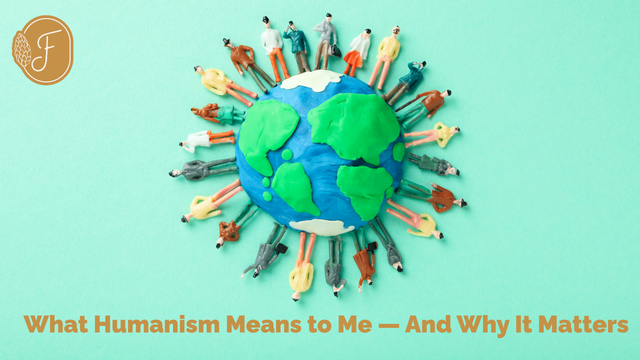
As World Humanist Day approached, I’ve found myself reflecting on a question that I’ve been asked many times over the years:
It’s a fair question. Humanism is often misunderstood, and many people assume it is simply the absence of religion. In reality, Humanism is much more than that.
For me, Humanism isn’t about what I don’t believe. It’s about how I choose to live.
At its heart, Humanism is rooted in kindness, compassion, fairness, reason, and a belief that every person deserves dignity and respect. It encourages us to take responsibility for our actions, care for one another, and make the most of the one life we know we have.
Those values may sound familiar because they are. They are values shared by people from all walks of life, regardless of their background, beliefs, or culture.
Humanism asks us to look to one another for support, to build communities based on understanding and empathy, and to recognise our shared humanity.
Humanism in Everyday Life
One of the things I love most about Humanism is that it isn’t something that only exists in books or philosophical discussions.
It’s found in everyday acts of kindness.
It’s in the neighbour who checks in on someone living alone.
It’s in the volunteer giving up their time to support a local cause.
It’s in the friend who sits quietly beside someone who is grieving.
It’s in the people who choose compassion over judgement and understanding over division.
For me, Humanism has never been about having all the answers. It has always been about trying to make a positive difference to the people around us.
Why It Matters To Me
Throughout my work as a Humanist Celebrant, I have been privileged to stand alongside people during some of the most important moments of their lives.
I’ve witnessed incredible joy at weddings, profound love at funerals, and powerful moments of connection during naming ceremonies and memorial events.
What strikes me every time is that, regardless of our backgrounds or beliefs, people are often searching for the same things: love, belonging, purpose, understanding, and connection.
Humanism recognises that meaning is something we create together through our relationships, our actions, and the impact we have on others.
That belief has shaped not only my work as a celebrant but also my commitment to The Fuze Foundation.
Humanism in Action
As Chair of The Fuze Foundation, I see Humanism not as an abstract philosophy but as something that should inspire action.
It influences how we support families experiencing hardship.
It shapes our commitment to equality, inclusion, education, and compassionate care.
It drives our work to tackle funeral poverty, provide free resources to communities, and support charitable organisations making a real difference in people’s lives.
Since our foundation was established, together we have contributed more than £122,000 back into communities, charities, and projects that align with our values.
But for me, Humanism has never been simply about raising money.
It’s about building connections.
It’s about listening.
It’s about standing alongside people when they need support.
It’s about recognising that every one of us has the capacity to make life a little better for someone else.
Celebrating World Humanist Day
World Humanist Day, celebrated around the Summer Solstice, is an opportunity to pause and reflect on what unites us rather than what divides us.
It reminds us that while we may hold different beliefs, come from different backgrounds, or walk different paths through life, we share something fundamentally important: our humanity.
At a time when the world can sometimes feel divided, that feels more important than ever.
Today, I’m grateful to be part of a community that values kindness, compassion, reason, equality, and human connection.
Not because Humanists believe we are perfect.
But because we believe people are capable of extraordinary kindness, growth, and generosity when given the opportunity.
And that’s something worth celebrating.
Happy World Humanist Day.
About the Author
Morag Webster is a Humanist Celebrant with Fuze Ceremonies and Chair of The Fuze Foundation. She has spent many years supporting people through some of life’s most significant moments, from weddings and naming ceremonies to funerals and memorials.
Passionate about equality, inclusion, compassion, and community, Morag believes that ceremonies should celebrate the unique stories that make us who we are. Through her work with both Fuze Ceremonies and The Fuze Foundation, she is committed to putting Humanist values into action by supporting individuals, families, charities, and communities across Scotland.
When she’s not conducting ceremonies or working on Foundation projects, Morag can often be found volunteering in her local community, supporting youth organisations, or spending time with her family on Scotland’s beautiful west coast.