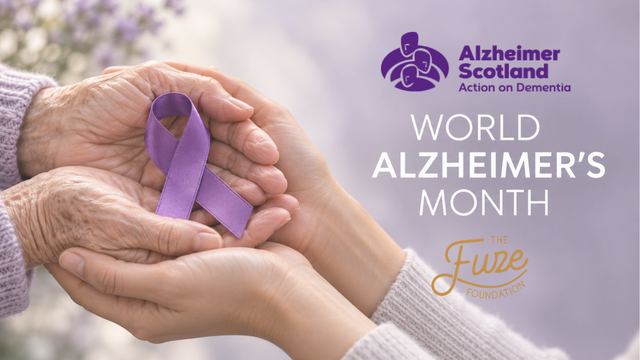
Every September, World Alzheimer’s Month brings people and organisations together to raise awareness of Alzheimer’s disease and other types of dementia, challenge stigma and encourage more open conversations.
For many people, dementia can feel frightening or difficult to talk about. There may be uncertainty about what different terms mean, which changes to look out for or where to turn for help. Yet greater understanding can make an enormous difference. It can help someone feel less alone, encourage families to seek advice and remind us all that a diagnosis does not change the value, identity or humanity of the person receiving it.
This World Alzheimer’s Month, we are proud to highlight the work of Alzheimer Scotland, one of The Fuze Foundation’s chosen charity partners for 2026/27, and share some important information about Alzheimer’s disease and the support available.
What is the difference between dementia and Alzheimer’s disease?
Dementia is not a single disease. It is an umbrella term covering more than 100 different conditions and sets of symptoms that affect how the brain works.
Alzheimer’s disease is the most common type of dementia. It is a progressive condition, meaning that its effects develop over time. Abnormal proteins build up in the brain, damaging brain cells and affecting memory, thinking, communication and behaviour.
Other types of dementia include vascular dementia, Lewy body dementia and frontotemporal dementia. Some people may also live with more than one type at the same time.
Although people may share some experiences, dementia affects everyone differently. Each person remains an individual, with their own history, relationships, preferences, abilities and personality.
What changes might someone notice?
Changes associated with Alzheimer’s disease can be subtle at first and may look different from one person to another. They can include:
- memory loss that begins to affect everyday life
- difficulty finding the right words or following a conversation
- becoming confused about time or place
- finding familiar tasks or decisions more difficult
- changes in mood, confidence, behaviour or personality
- becoming more withdrawn from work, hobbies or social activities
Experiencing one or more of these changes does not necessarily mean that someone has dementia. Memory and concentration can be affected by many things, including stress, depression, medication and other health conditions. However, if changes are persistent or causing concern, speaking to a GP is an important first step.
It can feel daunting to begin that conversation, but seeking advice may help identify the cause and open the door to information, treatment and support.
Living well with dementia
There is currently no cure for dementia, but that does not mean there is no help or hope. With the right support, people can and do live well with dementia for many years.
Practical information, treatment where appropriate, meaningful activity, supportive relationships and access to local services can all help someone maintain independence and quality of life. Support also matters enormously for family members and friends, whose own lives may change as they take on caring responsibilities.
Sometimes the most valuable thing any of us can offer is patience. Allowing someone time to find their words, including them in conversations, listening without correcting every detail and continuing to see the person rather than the diagnosis can all make a difference.
How Alzheimer Scotland helps
Alzheimer Scotland supports people living with dementia, their families and carers in communities throughout Scotland. Its work includes:
- providing information and emotional support through its 24-hour Freephone Dementia Helpline
- offering local support through Brain Health and Dementia Resource Centres
- connecting people with Dementia Advisers, groups and community activities
- helping communities build a better understanding of dementia
- campaigning for high-quality care and support
- supporting research into dementia prevention, care and cure
Whether someone is worried about changes they have noticed, has recently received a diagnosis, is living with dementia or is supporting somebody they love, help is available.
Alzheimer Scotland’s 24-hour Freephone Dementia Helpline can be reached on 0808 808 3000.
Why The Fuze Foundation is proud to offer its support
At The Fuze Foundation, our work is rooted in humanist values: compassion, dignity, equality and a belief in the importance of human connection. These values are reflected every day in Alzheimer Scotland’s work with people living with dementia and the families and carers beside them.
Many within our community have personal experience of dementia. Our celebrants also regularly meet families whose stories have been shaped by it; stories filled not only with difficulty and loss, but with love, humour, resilience and precious memories.
That is why we are so proud to have Alzheimer Scotland as one of our charity partners for 2026/27 and to support the difference it makes across Scotland. Through our fundraising and charitable giving, we are helping an organisation that ensures people affected by dementia can find information, understanding and a listening ear when they need it most.
Turning awareness into understanding
World Alzheimer’s Month gives us an opportunity to learn, share trusted information and challenge the assumptions that can leave people feeling isolated.
You can help by starting a conversation, sharing details of the support available, learning how to communicate more confidently with someone living with dementia, fundraising or donating to Alzheimer Scotland. Small acts of patience, kindness and inclusion can help create communities in which nobody has to face dementia alone.
To learn more, find support or get involved, visit www.alzscot.org.
If you are concerned about yourself or someone you love, call Alzheimer Scotland’s 24-hour Freephone Dementia Helpline on 0808 808 3000.