Who married, where they celebrated and how Scotland said I do
Scotland said “I do” a little more often in 2025.
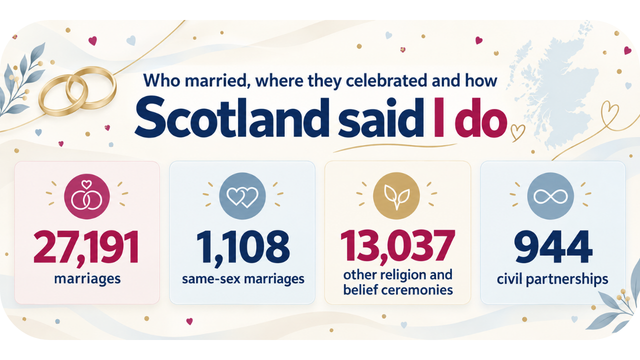
The latest National Records of Scotland figures show 27,191 marriages, 236 more than in 2024. The headline is encouraging, but the detail tells a much richer story: couples are marrying later, Scotland continues to attract people from elsewhere in the UK and beyond, and belief-led ceremonies remain at the heart of the wedding landscape.
The 2025 picture at a glance
- 27,191 marriages, up 236 or 0.9% from 2024.
- 1,108 same-sex marriages, representing just over 4% of all marriages.
- 12,388 civil ceremonies, almost unchanged from 2024.
- 13,037 other religion and belief ceremonies, up 362 and accounting for 47.9% of all marriages.
- 944 civil partnerships, the highest total since 2006 and 18.6% higher than in 2024.
How Scotland chose to marry
Civil ceremonies remained the single largest broad category at 12,388, or 45.6% of all marriages. However, ceremonies conducted by other religions and belief bodies reached 13,037, or 47.9%. Since the pandemic, that broad group has remained larger than the civil total.
The figures show a continuing shift away from Scotland’s largest traditional churches. Church of Scotland marriages fell from 1,252 to 1,138, while Roman Catholic marriages fell from 647 to 627. Couples are clearly looking across a wider range of ceremony styles and belief bodies when deciding how their day should feel.
The Fuze Foundation conducted 1,459 legal marriages in 2025. That places us second among the named Humanist organisations in the NRS table. It is a powerful reflection of the trust couples place in our celebrants and in personal, meaningful Humanist ceremonies.
Who was getting married
The average age at marriage continued to rise. In 2025 it was 38.1 for women and 40.2 for men, compared with 37.8 and 40.0 in 2024. For couples where both people had never married before, the averages were lower at 32.8 for women and 34.5 for men.
People aged 30 to 34 still formed the largest age group, but marriage is certainly not only a younger person’s milestone. Across men and women, 7,783 people marrying in 2025 were aged 55 or over. That was 400 more than in 2024 and represented more than one in seven people getting married.
Around three quarters of those marrying had never married before. At the same time, roughly one in five had previously been divorced, reminding us that many ceremonies celebrate a new chapter, blended families and love found again.
Same-sex marriages and civil partnerships
There were 1,108 same-sex marriages in 2025, up from 1,086 the year before. Of these, 699 were marriages between women and 409 were marriages between men.
Civil partnerships rose even more sharply, from 796 to 944. Mixed-sex couples accounted for 778 of them, or 82%, following the law change that made mixed-sex civil partnerships available in Scotland. The remaining 166 were same-sex civil partnerships.
Where Scotland said I do
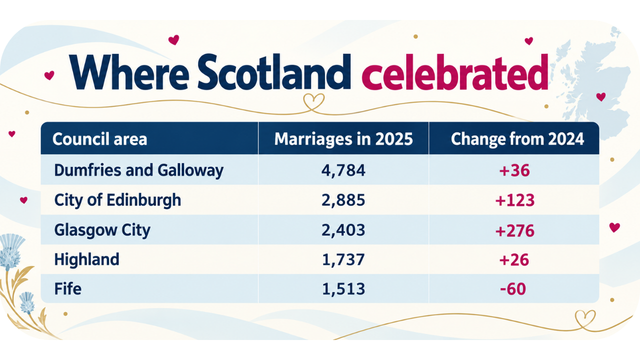
The geography is one of the most striking parts of the release. Dumfries and Galloway recorded 4,784 marriages, 17.6% of the Scottish total, reflecting its enduring appeal as a destination-wedding area. Edinburgh recorded 2,885 marriages and Glasgow 2,403. Together, those three areas accounted for 37% of all marriages registered in Scotland.
The residence figures underline Scotland’s destination appeal. In 19,874 marriages, both parties lived in Scotland. In a further 5,731, both lived elsewhere in the UK. That means more than one in five Scottish marriages involved two people resident in another part of the UK.
The country-of-birth figures also show the diversity of modern Scotland. Both parties were UK-born in 21,650 marriages. In the remaining 5,541, just over one in five, at least one person had been born outside the UK.
What the figures really tell us
There is no single version of a Scottish wedding. Couples are marrying at different ages, bringing different life experiences and family stories, travelling to Scotland from near and far, and choosing ceremonies that reflect what they genuinely believe.
That is exactly why a Humanist ceremony can feel so special. It gives couples the freedom to place their own story, values and personalities at the centre, while still enjoying a fully legal marriage led by an authorised celebrant.
Planning your own ceremony
Whether you are planning a large celebration, an intimate gathering, a destination wedding or a beautifully simple ceremony, our team would love to help you create something that feels unmistakably yours. Explore Humanist weddings with Fuze Ceremonies or meet our celebrants across Scotland.
Sources
National Records of Scotland 2025 annual statistical tables of vital events. Figures principally use tables 1.03 and 7.01 to 7.12. Council figures relate to the area in which marriages were registered, not necessarily where couples lived.